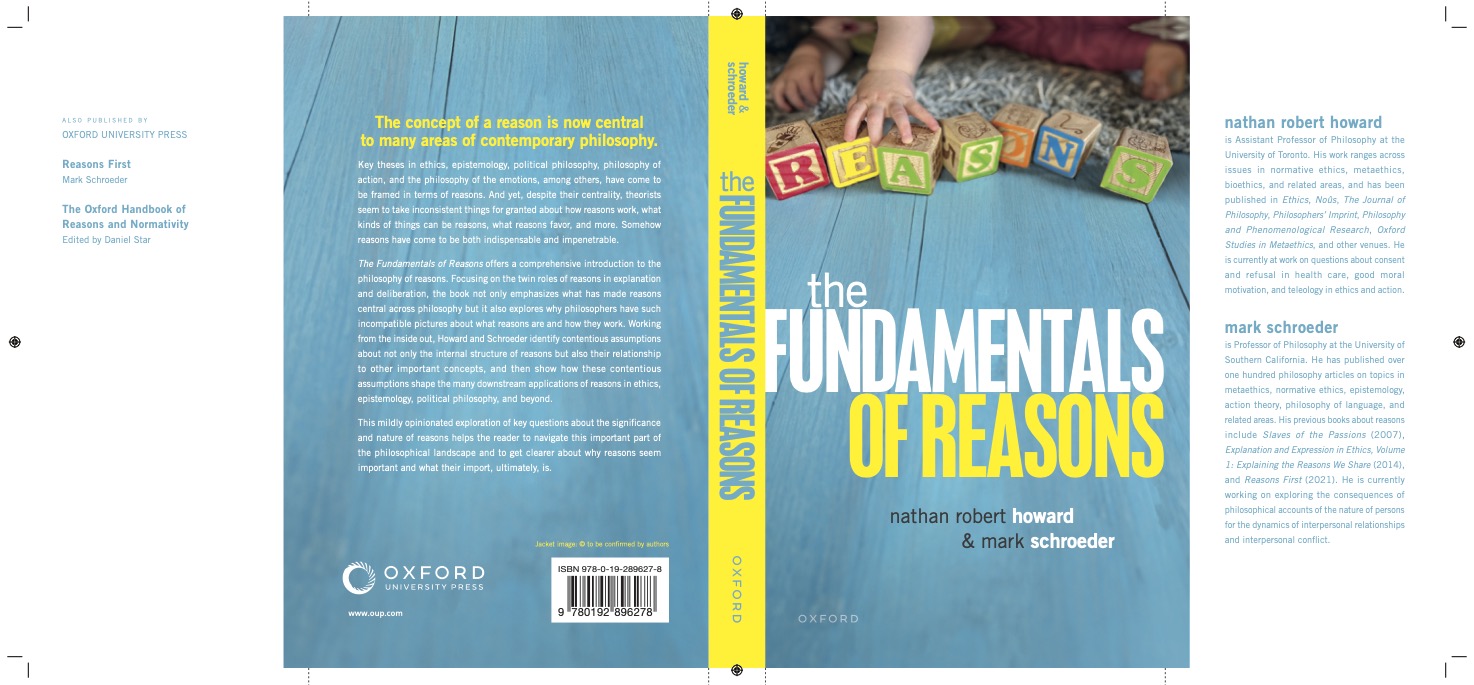
The concept of a reason is now central to many areas of contemporary philosophy. Key theses in ethics, epistemology, political philosophy, philosophy of action, and the philosophy of the emotions have come to be framed in terms of reasons. And yet theorists seem to take inconsistent things for granted about how reasons work, what kinds of things can be reasons, what reasons favor, and more. Somehow reasons have come to be both indispensable and impenetrable.
The Fundamentals of Reasons offers a comprehensive introduction to the philosophy of reasons. Focusing on the twin roles of reasons in explanation and deliberation, the book emphasizes what has made reasons central across philosophy while exploring why philosophers have such incompatible pictures about what reasons are and how they work. Working from the inside out, we identify contentious assumptions about the internal structure of reasons and their relationship to other important concepts, and show how these assumptions shape downstream applications in ethics, epistemology, political philosophy, and beyond.
Oxford University Press · Amazon · PhilPapers
This chapter introduces the two roles that have made reasons central across philosophy — their role in explanation and their role in deliberation — and motivates the strategy of exploring reasons from the inside out. The chapter previews the book's three-part structure, moving from the internal composition of reasons to their connections with neighboring concepts and finally to their place in normative theory.
This chapter begins the task of exploring reasons from the inside out with the question of what kind of thing reasons can be. Reason diagrams are introduced as a way of thinking about the internal structure of the reason relation that is neutral between different theories and different senses of 'reason'. Evidence bearing on the answer is marshaled from the language of 'reason' ascriptions and from each of the explanatory and deliberative roles for reasons. Some philosophical consequences of different answers are explored.
This chapter examines the relationship between reasons and arguments. It explores whether reasons can be understood as premises in arguments for conclusions about what to do or believe, and considers the challenges this picture faces — including questions about how the premises of such arguments relate to the normative conclusions they are supposed to support.
This chapter completes Part 1 by investigating the internal structure of reasons. It examines questions about whether reasons have parts — for example, whether a reason to act is constituted by both a fact and a goal, as on the dual aspect view — and how different views of reasons' internal structure bear on the explanatory and deliberative roles introduced earlier.
This chapter opens Part 2, which moves outward from the internal workings of reasons to explore their connections with closely related concepts. The idea that objective and subjective reasons correspond to two distinct dimensions of normative assessment is introduced, as well as the framework of thinking of subjective reasons as imposing some perspective. Two components of this perspective are distinguished — the mind-to-world and the world-to-mind — and the relative priority of objective and subjective reasons is explored.
This chapter considers the relationship between reasons and evidence. It examines the view that reasons just are evidence about what one ought to do, explores the attractions of this reductive picture, and develops challenges for it — including problems arising from the idea that evidence is factive while reasons may not be, and from cases where evidence and reasons appear to come apart.
This chapter considers the relationship between reasons and explanation. The explanatory role of reasons establishes some connection to explanation but underspecifies what it is. The chapter begins with the idea that this connection comes from the nature of reasons, because what it is to be a reason is to be an explanation of something. Problems for the idea that reasons are explanations of what you ought to do are introduced and addressed. Fallback views — that reasons are explanations of value, desire-promotion, or mass noun reason — are compared. And the alternative idea that the explanatory role comes not from the nature of reasons, but from the nature of ought, is introduced and motivated.
This chapter concludes Part 2 by considering the relationship between reasons and reasoning or deliberation. The deliberative role of reasons establishes some connection to deliberation but underspecifies what it is. Various forms of the Reasoning View develop this connection into a hypothesis about what it is for something to be a reason. Problems for simple formulations are introduced and developed that challenge both its necessity and its sufficiency for something to be a reason for action, and parallels are drawn with problems for the thesis of Reasons as Evidence.
This chapter opens Part 3, which considers the place of reasons in normative theory. It explores which normative concepts might be analyzed in terms of reasons — including ought, value, and fittingness — and introduces the wrong kind of reason problem as a central obstacle for such analyses. Different responses to this problem are surveyed, including attempts to restrict the scope of reasons-based analysis and attempts to distinguish between different kinds of reasons.
This chapter turns the question around: rather than asking what reasons can analyze, it asks what can analyze reasons. It considers views on which reasons are themselves explained by or grounded in other normative concepts — such as value, ought, or fittingness — and explores whether reasons are genuinely fundamental in the normative domain or whether they inherit their significance from some more basic source.
This chapter considers complications that arise in thinking about how reasons weigh against one another in determining or explaining what we ought to do. The epiphenomenal challenge is introduced: once we see what does the work in the competition of reasons against one another, we may worry that all that matters is their weights and that reasons themselves wash out of the explanation as epiphenomenal. The connection between this challenge and the view that it is the mass noun, rather than the count noun, use of 'reason' that is central is explored, and an alternative picture is tentatively developed.
The final chapter draws together the threads of the book to assess the fundamentality of reasons — whether the concept of a reason is the most basic building block of normative theory or whether, despite its centrality, it derives its significance from somewhere else. The chapter reflects on what the preceding investigations reveal about the prospects and limits of reasons-first approaches to normativity.